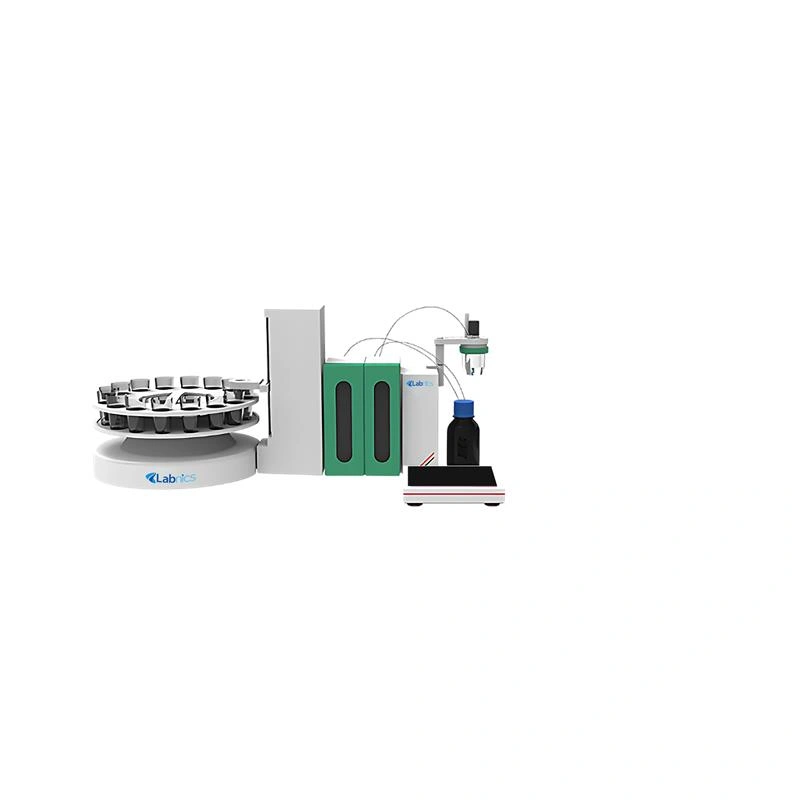
Automatic Potentiometric Titrator NAPT-200 comes with a 250 ml titration cup and operates within a temperature range from -5°C to 120°C. It features a modular design for simplified operation and flexible setup. This unit supports polarized electrodes for specialized analytical methods. It includes programmable parameters for customized titration operations. Our automatic potentiometric titrator supports various titration types for advanced analysis.
| Measuring Range | mV: -2000.0 mV to +2000.0 mV pH: -20.000 pH to +20.000 pH |
| Resolution | mV: 0.1 mV pH: 0.001 pH |
| Precision | mV: 0.1 mV pH: 0.002 pH |
| Measurement Modes | MEAS: Measure pH/mV/Temperature CAL: pH calibration (multi-point) SET: End point setting MET: Equivalent titration DET: Dynamic titration |
| Titration Modes | Acid-base titration Redox titration Precipitation titration Complexometric titration Non-aqueous titration |
| Titration Cup Capacity | 250 ml |
| Temperature Range | -5°C to 120°C |
| Temperature Accuracy | ±0.1°C |
| Communication | USB, RS-232, Ethernet |
| Dosing System | Built-in with 2 titration channels, expandable to 8 |
| Burette Specifications | 1 ml, 5 ml, 10 ml, 25 ml, 50 ml (10 ml standard) |
| Burette Resolution | 1/48,000 |
| Control Unit | PC with optional software |
| Autosampler | Compatible with GT robotic system for large sample batches |
| Functions | Auto self-check, calibration, and editable application setting |
| Storage | Internal storage over 300 GB with method saving |
| Compliance | FDA, GMP, GLP |
| Micro Detection Electrode | Yes |
| Micro Syringe Pump | Yes |
| Pipeline | Corrosion-resistant PTFE |
| Stirring Method | Magnetic or overhead spiral stirring |
| PTFE Valve | Imported anti-corrosion rotary valve |
Automatic Potentiometric Titrator NAPT-200 is used for acid-base, redox, precipitation, and complexometric titrations, including the analysis of oxalic acid, iodine value, iron (II), chloride, calcium, sulphur dioxide, and total acidity in various samples.