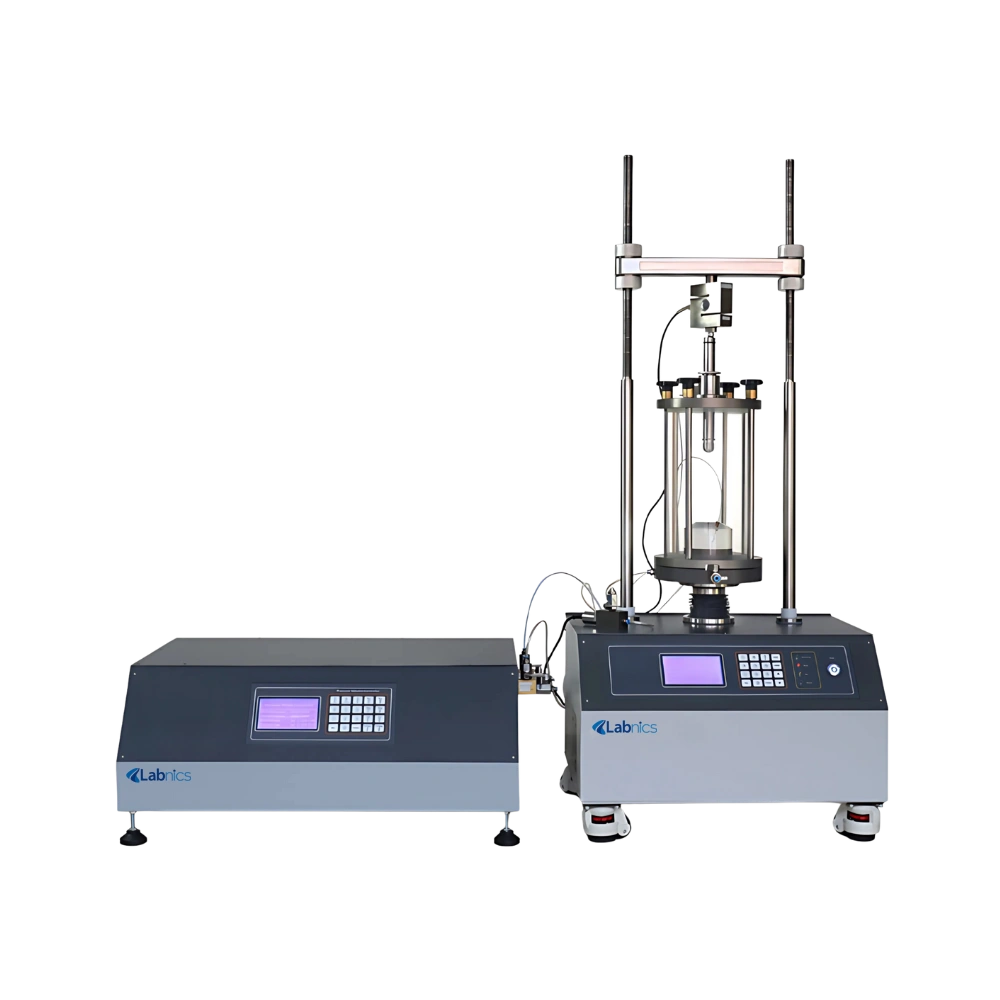
FAQ for Semi-Automatic Triaxial Tester NATT-101
1: What types of tests can this Semi-Automatic Triaxial Tester NATT-101 perform?
The Semi-Automatic Triaxial Tester NATT-101 supports a wide range of geotechnical tests including consolidated drained, consolidated undrained, and unconsolidated undrained tests. Its programmable settings allow researchers to replicate field stress conditions with exceptional precision.
2: How does automation benefit triaxial testing in Semi-Automatic Triaxial Tester NATT-101?
Semi-Automatic Triaxial Tester NATT-101 has automation that minimizes human error, ensures uniform load application, and allows unattended test runs. This means laboratories can handle higher workloads without compromising accuracy or data quality.
3: Is the Semi-Automatic Triaxial Tester NATT-101 suitable for high-pressure soil testing?
Yes, the Semi-Automatic Triaxial Tester NATT-101 is built to withstand high confining pressures, making it suitable for testing cohesive soils, dense sands, and other materials under extreme stress conditions common in deep foundation studies.
4: Can the Semi-Automatic Triaxial Tester NATT-101 integrate with lab data systems?
Absolutely. The Semi-Automatic Triaxial Tester NATT-101 can connect to laboratory information systems or standalone software, enabling real-time monitoring, data logging, and easy export of results for reports and further analysis.
5: What makes this Semi-Automatic Triaxial Tester NATT-101 ideal for long-term use?
Semi-Automatic Triaxial Tester NATT-101 robust mechanical design, precision-engineered components, and low-maintenance operation ensure years of reliable performance. Regular calibration and simple upkeep keep it operating within optimal accuracy limits.
6: What is the primary use of an Automatic Triaxial Tester?
An Automatic Triaxial Tester is used to measure the mechanical behavior of soil under simulated field stress conditions. It helps determine properties like shear strength, deformation, and consolidation, which are critical for geotechnical project design and analysis.
7: How does automation improve triaxial testing?
Automation ensures precise control of loading, pressure, and data recording during testing. This reduces human error, improves consistency between tests, and saves time in both academic and commercial geotechnical applications.
8: What testing modes can an Automatic Triaxial Tester support?
Most advanced models support multiple modes, including saturation, consolidation, and shear strength tests such as UU, CU, and CD. This versatility allows engineers and researchers to conduct comprehensive soil behavior studies in a single system.
9: Why is accurate pore pressure measurement important in triaxial testing?
Accurate pore pressure measurement ensures reliable analysis of effective stress within soil samples. This data is crucial for understanding stability and load-bearing capacity in construction and infrastructure projects.
10: In which industries is the Automatic Triaxial Tester commonly used?
It is widely used in civil engineering, geotechnical consulting firms, academic research institutions, and construction quality control laboratories. These industries rely on it for designing safe and efficient foundations, embankments, and earth structures.